


Sustainability Vision - Asahi Kasei Group’s Vision
Asahi Kasei's Group Philosophy and Sustainability Goals
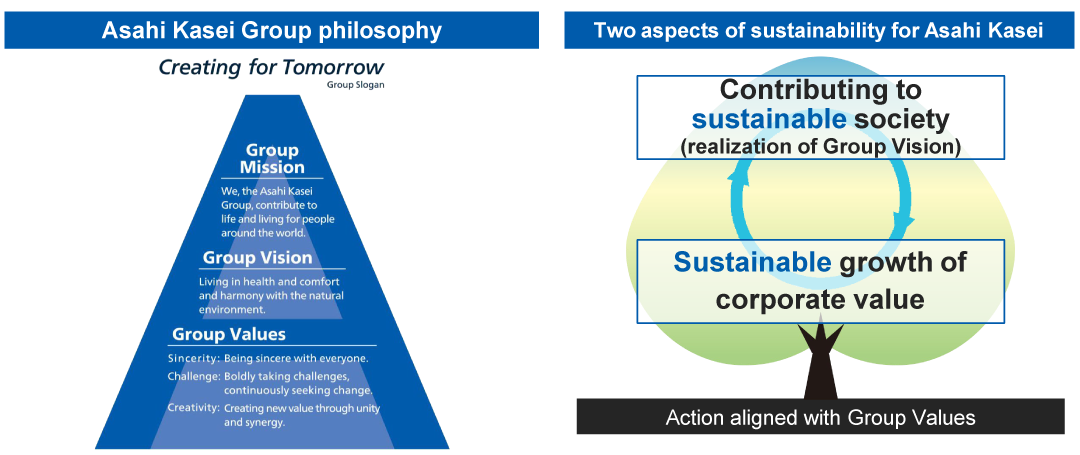
The Asahi Kasei Group conducts corporate activities to provide new value to society by realizing its Group Vision of “living in health and comfort” and “harmony with the natural environment.” We aim to achieve two mutually reinforcing aspects of sustainability: contributing to sustainable society and sustainable growth of corporate value.
The Direction of Sustainability with a View Toward 2050 - Care for People, Care for Earth
As exemplified by the problems of climate change and aging of the population, Asahi Kasei’s commitment to “Care for People, Care for Earth” has become even more important.
As we look ahead to 2050, we can expect to see a variety of social issues. We believe that we will be able to help resolve these issues while expanding our business opportunities.
For example, in terms of “Care for Earth”, we can contribute to electric vehicles, a hydrogen society, carbon recycling, and achieving a circular economy among other important subjects, primarily through our businesses in the Material sector with battery materials, an alkaline water electrolysis system, CO2 separation and capture, recycling technology, and use of biomass, etc. We can also contribute in the Homes sector by supplying insulation materials and Net Zero Energy House (ZEH).
To achieve a carbon neutral world, it is essential to reduce GHG emissions from our business activities. We have established the Asahi Kasei Group's Carbon Neutrality Policy and are working to achieve this goal.
- Note:For more information on policies and initiatives, see Climate Change.
In terms of “Care for People”, we will contribute to the development of homes and communities that can withstand storm and flood damage and extreme heat as climate change progresses. We will also contribute through our health care and other businesses, with pharmaceuticals and medical devices, to help people live healthy and active lives.
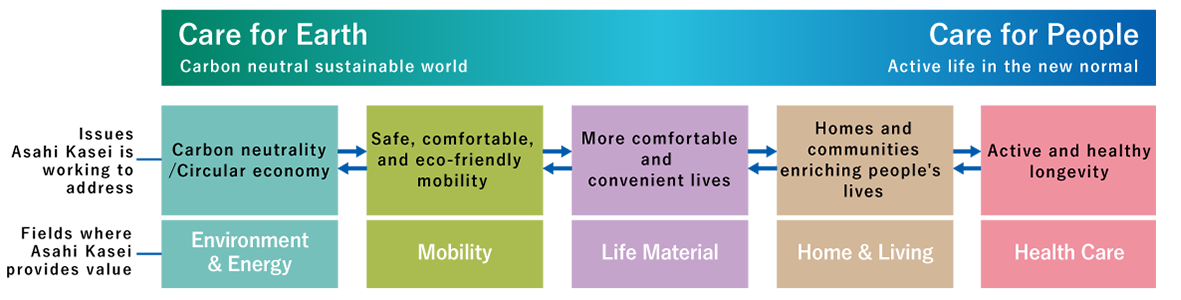
In addition to aiming to provide value to society through our two challenges, we will enhance the fundamental activities that support our business activities, such as corporate governance, compliance, respect for human rights, and safety and quality. Our group will also pursue our two sustainability goals of contributing to sustainable society and sustainable growth of corporate value.
Care for Earth - Achieving a Carbon Neutral and Sustainable World
The Asahi Kasei Group is working to develop products and services in a wide range of fields from upstream to downstream in the value chain, including raw materials, manufacturing processes, energy, product use, and product recovery, with the aim of realizing a carbon neutral sustainable world.
Initiatives for Achieving a Hydrogen Society
| Significance of the initiatives | As a clean fuel and raw material, hydrogen is essential for achieving carbon neutrality |
|---|---|
| Our vision | Contribute to a hydrogen society and green hydrogen production centered on water electrolysis technology |
| Specific initiatives | Development and provision of large-scale alkaline water electrolysis system |
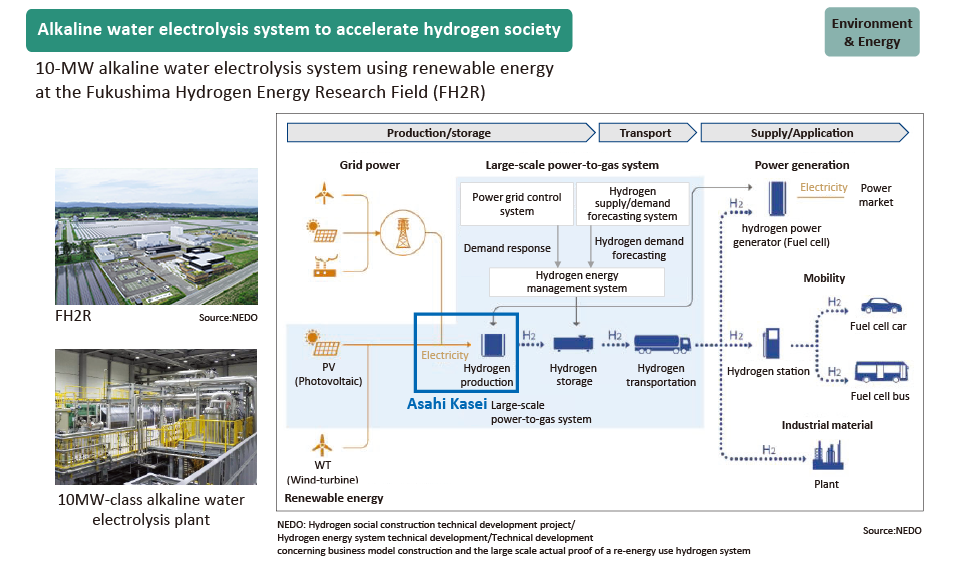
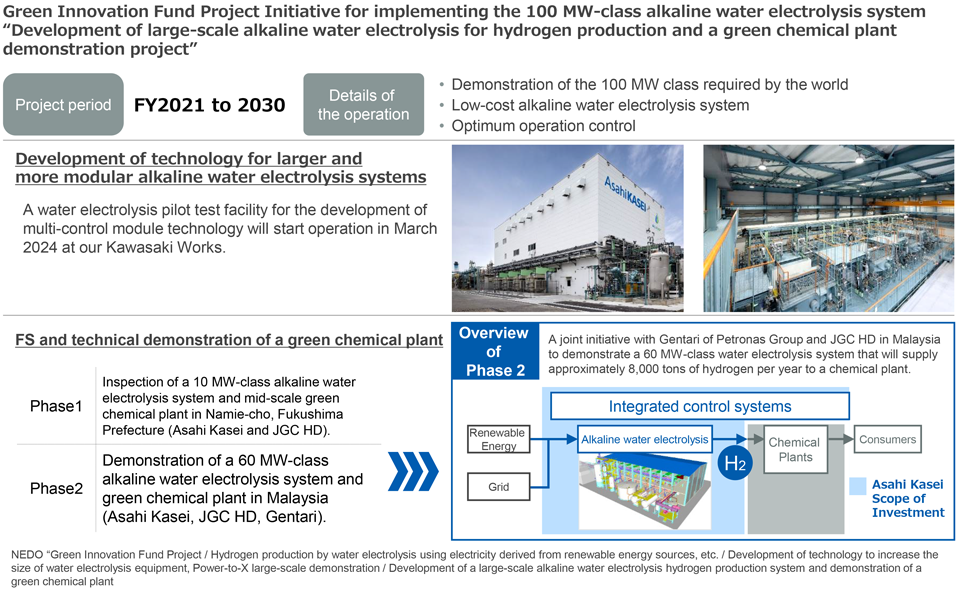
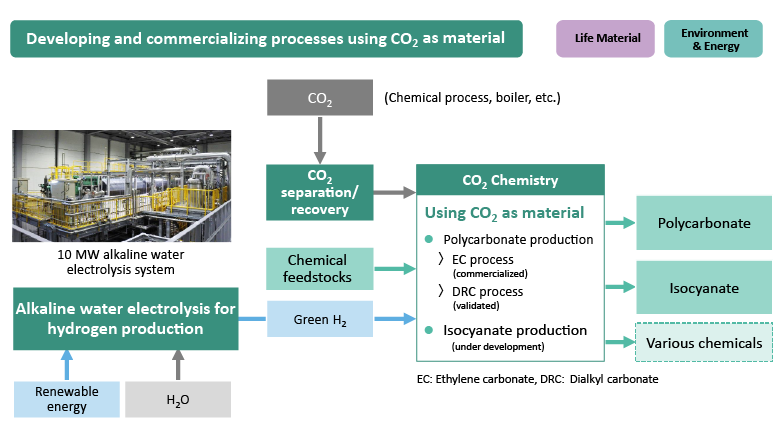
Hydrogen, which has garnered attention as a fuel for automobiles and power generation, as a raw material for chemicals, and as a means of storing and transporting energy, is an essential substance to achieve carbon neutrality. While many countries around the world have announced their hydrogen strategies and as global expectations for hydrogen rise, we launched a 10 MW-scale alkaline water electrolysis system in Namie Town, Fukushima Prefecture in 2020, based on our knowledge of chlor-alkali electrolysis systems and electrochemistry as well as our technological development capabilities, to demonstrate the efficient production of hydrogen using renewable energy. We completed a water electrolysis pilot test facility with four water electrolysis modules integrated in parallel at our Kawasaki Works in March 2024, and began demonstration operations to verify the performance of multi-module control technology and new components. As well as developing a large 100 MW-scale water electrolysis system that is in demand around the world, we are also working with JGC Holdings Co., Ltd. to establish technology for integrated control of green chemical plants that use hydrogen produced by the water electrolysis system. In addition, from September 2024, we began a collaboration with Italy’s Industrie De Nora S.p.A. on the development of a pressurized container-type water electrolysis system to meet a broader range of customer needs. We are also planning to build new facilities in the Kawasaki Works to establish a product supply system, and in December 2024 the project was selected for the Ministry of Economy, Trade and Industry’s GX Supply Chain Development Support Program. Our aim is for early commercialization through collaboration with partner companies in the upstream and downstream supply chain and through participation in projects around the world.
Producing Chemicals using CO2
| Significance of the initiatives | CO2 recycling is an important element of a sustainable society |
|---|---|
| Our vision | Practical application of CO2 chemistry in addition to polycarbonate |
| Specific initiatives | Production of functional specialty chemicals based on carbonyl group introduction technology |
We are also focusing on CO2 chemistry, which enables the production of chemical products using CO2 as a raw material.
In the area of polycarbonate production technology, the EC process has been used in practical applications and is being licensed around the world. The DRC process, which is a further refinement of the EC process, has already been demonstrated as viable and is attracting attention as a technology that enables production regardless of the location of petrochemical plants. We are also developing a technology to produce isocyanate (raw material for polyurethane) from CO2. We have also started to use the EC process as a basis for the production of electrolyte materials for LIBs (lithium-ion batteries), which will become even more essential in society going forward. With regard to CO2 separation and capture, we are developing a system that uses our catalyst technology to efficiently separate and capture CO2 from power plant and factory exhaust gas using a special zeolite (a type of mineral) with a precisely controlled pore structure.
Revolefin™ technology: Production of basic chemicals from bioethanol
| Significance of the initiatives | Reducing the use of fossil resources and CO2 emissions, making non-recyclable materials sustainable |
|---|---|
| Our vision | Contribute to the production of chemical products that do not rely on fossil resources through the practical application of technology in society |
| Specific initiatives | Manufacturing basic chemicals* from bioethanol |
- *Ethylene, propylene, C4, benzene, toluene, xylene
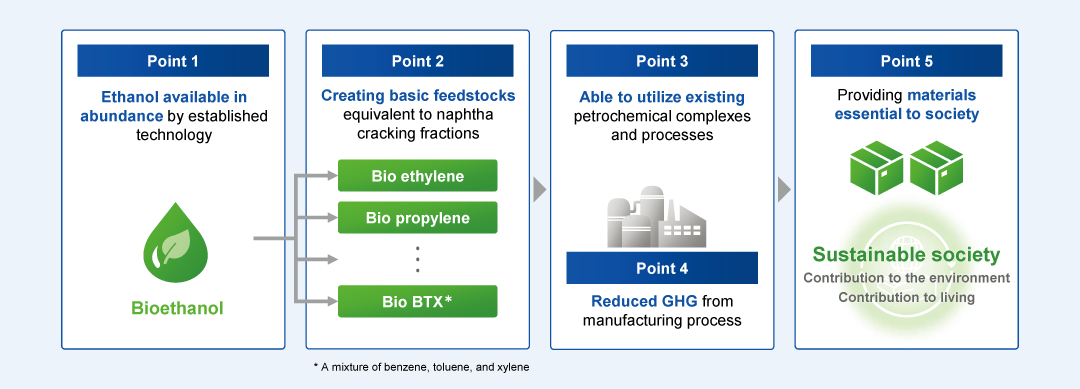
Despite the 3R (reduce, reuse, recycle) efforts currently underway in various countries, not all materials are suitable for recycling. There are a variety of materials that are technically difficult to recycle and those that are difficult to recover, and there are materials that can be recovered but are difficult to separate. In addition to the 3Rs, if we increase the use of biomass-derived plastics, the use of fossil resources can be reduced, and further CO2 reduction effects can be expected.
We are currently developing new technology to produce basic chemicals from bioethanol by applying the catalyst and process technology cultivated in our petrochemical business. Conventionally, it is possible to produce ethylene from ethanol through catalytic dehydration. If commercialized, our new technology will enable the production not only of ethylene, but also light olefins such as propylene, and aromatics such as benzene, toluene, and xylene, in a single plant. This will make it possible to manufacture many daily necessities from biomass raw materials, including products that have been considered difficult to manufacture using non-fossil resources.
Care for People - Realizing Active Lives
Realizing safe, secure, and sustainable living
| Significance of the initiatives | Realizing living that is resilient to disasters |
|---|---|
| Our vision | Homes where people can continue to live with peace of mind even after disasters |
| Specific initiatives | Development of earthquake-resistant and vibration damping structures, and establishment of restoration support systems |
Japan is a country prone to disasters. In recent years, natural disasters have become more frequent and more severe, increasing in seriousness year by year.
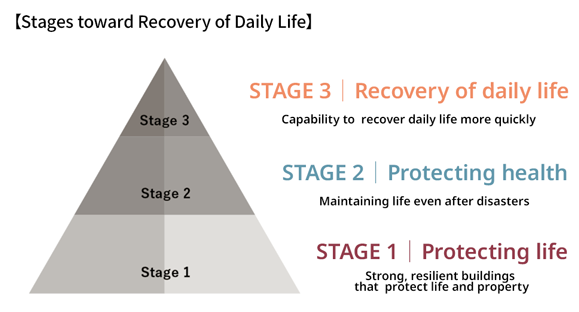
At Asahi Kasei Homes, we regard natural disasters as unavoidable and have adopted the concept of “total resilience”—comprehensive disaster preparedness that looks beyond disaster occurrence to the recovery of daily life—as the basis for our homes and services.
This approach integrates building performance, planning, and support to ensure preparedness against disasters.
For housing, we use Hebel™ autoclaved aerated concrete with excellent earthquake and fire resistance, and incorporate equipment such as seismic damping systems, solar power generation, and storage batteries to enable sheltering at home even during disasters. On the design side, we further enhance safety with measures such as anti-toppling fixtures for furniture and storage planning for emergency supplies.
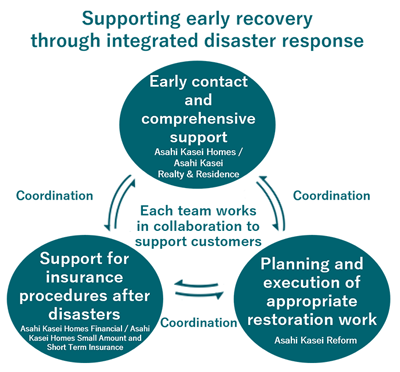
To support swift recovery after disasters, we have built a support framework in collaboration with our insurance and remodeling divisions, leveraging IT to enable rapid response in times of emergency. We believe that restoring homes also contributes to strengthening the recovery capability of entire communities.
We also promote preparedness in daily life through disaster-prevention seminars, information sharing, and disaster-prevention events held in community rental housing.
These efforts have been recognized with the Japan Resilience Award1 for seven consecutive years.
- 1An award program that recognizes and honors activities contributing to the development of a resilient nation, communities, people, and industries.
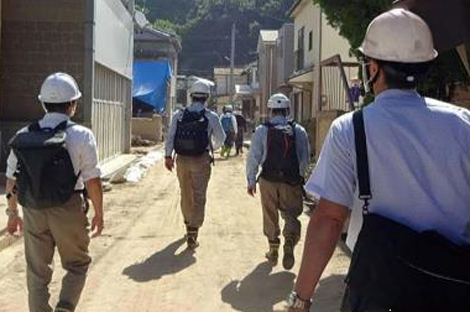 Employees heading out to support disaster-affected areas after the establishment of a task force
Contributing to the Resolution of Unmet Medical Needs
| Significance of the initiatives | Responding to unresolved health-related medical issues that are increasing due to the aging population, etc. |
|---|---|
| Our vision | Provide superior products and services globally |
| Specific initiatives | Pharmaceuticals, bioprocess products and services, and medical devices |
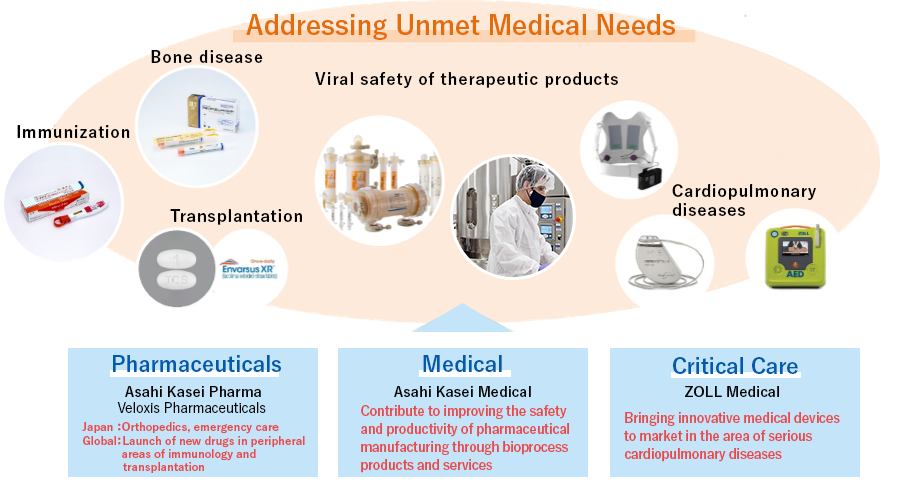
As health-related issues are becoming more common due to the aging of the population and other factors, we believe that addressing unmet medical needs will become ever more vital. Asahi Kasei is involved in both pharmaceuticals and medical devices, and aims to provide superior products and services throughout the world.
In the pharmaceutical business, we are focusing on specialty fields such as immunology and transplantation, kidney diseases, and severe infections in immunocompromised patients, while advancing our global development.
In the life science businesses, we will contribute to improving the safety and productivity of drug formulations in the bioprocess field by providing virus removal filters and CRO1/CDMO2 services.
In the critical care businesses, we will also focus efforts on marketing innovative medical devices in the area of serious cardiopulmonary related diseases.
- 1Biosafety testing contract research organization
- 2Next-generation antibody drug contract development and manufacturing organization
Related information
We will strive to further improve our corporate value through the implementation of our medium-term management plan.