


Water Resource Preservation
Click here to read our response to CDP Corporate Questionnaire 2025
- CDP Corporate Questionnaire 2025(Japanese Document)
- (References*)CDP Corporate Questionnaire 2025(English Document)
- *Our official response is in Japanese, and the English response is a machine translation.
Policy
Asahi Kasei Group's business is intrinsically related to water resources. Ensuring their sustainability is one of our societal missions and a prerequisite for the continuity of our business. We will contribute to the conservation of water resources around the world through our Japan and overseas filtration membrane module business (water supply, seawater desalination, etc.), the development of sludge reduction products for wastewater treatment, and the expansion of our surface oil detector series. We also have a policy of reducing our intake of water resources by ascertaining the quantity of our water withdrawals and maintaining and improving the efficiency of our water usage through circular use.
Target
Reduction of the environmental impact
As a chemical manufacturer that handles a large volume of chemical substances, chemical agents, and water, we believe it is important to responsibly secure the sustainability of water. We have therefore set the annual company-wide target of “zero environmental accidents or incidents.”
In order to prevent violations of laws and regulations, we use voluntary standards for wastewater quality in order to maintain a stricter level of control than general local regulations and manufacturing facilities.
In fiscal 2024, we achieved our target, with no violations or penalties.
Reducing water usage
The Asahi Kasei Group endeavors to reduce the amount of water used in each of our plants, to collect used water and reuse it circularly, and to reduce water withdrawals and discharges.
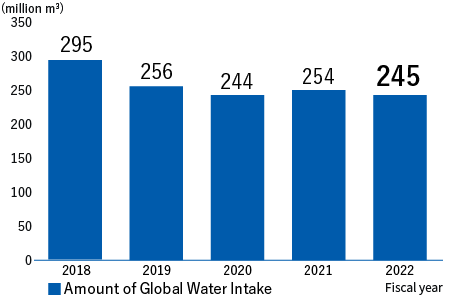 Amount of Global Water withdrawals (Japan and overseas)
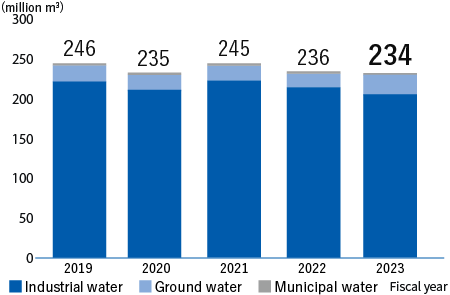 Amount of Water withdrawals by Source (Japan)
Water reuse initiatives
We strive to reduce water withdrawals and discharges through reuse of intake water. Primarily, we work on reusing water by repeatedly using the coolant water used for thermal exchange in equipment and facilities.
The water reuse rate* in fiscal 2024 (Japan) was about 2.0 times the amount of water withdrawals. Locations with high reuse rates include the Kawasaki Works: approx. 11.8 times; the Mizushima Works: approx. 3.8 times: and Moriyama Works: approx. 2.8 times.
We will continue working to reuse water from the perspective of long-term water resource security.
- *Water reuse rate = Amount of water used (including reused water) / water withdrawals
Prevention of water pollution
The Asahi Kasei Group is thorough in its water discharge management and leakage countermeasures in order to prevent contamination of bodies of water or groundwater. In addition, as an annual goal for group-wide environmental safety activities, we have set zero instances of leakage as covered by the Water Pollution Prevention Act.
In 2012, we issued our Guidelines on Wastewater Management. In addition to proceeding with confirmation of the state of wastewater management based on this, we are also working on enhancing the capacity of wastewater treatment facilities and other equipment.
The Asahi Kasei Group sets voluntary management targets for the quality of wastewater from our offices and plants, managing water quality to a higher level than wastewater regulation standards.
In fiscal 2024, there were neither instances of leakage as related to the Water Pollution Prevention Act nor violations or fines related to environmental laws and regulations.
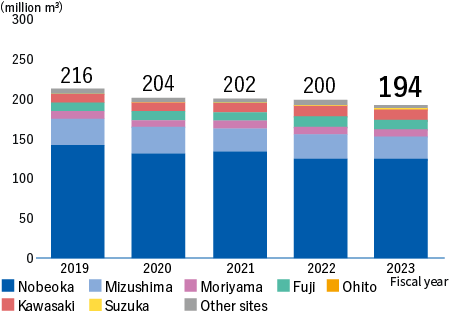 Amount of Wastewater (Japan)
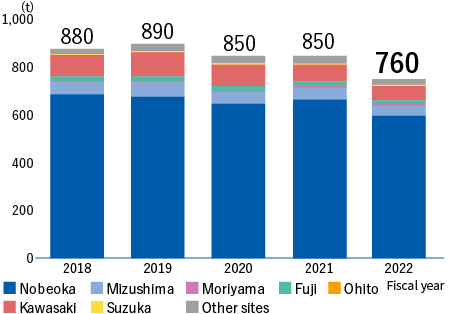 Chemical Oxygen Demand (COD) Load
Asahi Kasei products and technologies for water environmental issues
Microza™ hollow fiber filtration membrane
We are a supplier of water treatment membranes and filtration systems. Microza™ is a hollow fiber membrane we have developed for water treatment. It is used in more than 1,600 water purification plants and wastewater plants worldwide, including in the United States, China, Korea, Singapore, Thailand, Indonesia, and Middle Eastern countries.
Going forward, we will continue to work on global water environmental issues with the aim of resolving various problems related to water resources.
Saran™ Polyvinylidene Chloride Fiber
One important issue in wastewater treatment is reducing the amount of sludge generated, which is directly tied to decreasing its environmental impact. The Asahi Kasei Group conducts research and development into new commercial products that feature a unique technology using microorganism immobilized carrier that flows, making use of the characteristics of Saran™ fiber, which microorganisms inhabit easily.
Existing facilities can adopt these products by making simple improvements like installing screens, without requiring major modifications. This improves processing capabilities and reduces the amount of sludge generated.
Apolarm™ series environmental monitoring products
Asahi Kasei Technosystem's Apolarm™ Series detects a wide range of oil leaks, including floating oil (oil film and oil layers), sediment oil, and water-soluble oil. We will continue to expand our product line and protect the aquatic environment with oil detection devices for specific applications.
| Apolarm C | Oil layers of 3 mm or more trigger a capacitance shift and sound an alarm. |
|---|---|
| Apolarm M | A non-contact laser detector that can sense minuscule amounts of oil film on the water surface. |
| Apolarm B | Detects oil and organic solvents that have a greater specific gravity than water, causing them to sink. |
| Apolarm F | Detects leakage of fluorescent water-soluble oils. |