


Risk Management
Policy
The Asahi Kasei Group has established and is working to reinforce basic guidelines for risk management and emergency response in the Asahi Kasei Group's business operations in accordance with the Asahi Kasei Group Basic Regulation for Risk Management & Compliance.
Strengthening risk management
The Asahi Kasei Group has a variety of businesses across the three business sectors of Material, Homes, and Healthcare, and we are expanding business activities globally in a wide variety of fields. In this tumultuous business environment, we aim to reduce threats and capitalize on opportunities presented by changes and uncertainty that may impact Asahi Kasei Group management and business, by continuing to expand risk management activities as a united Group, through a combination of adapting to the characteristics of each sector and business and responding in an interorganizational manner across the Asahi Kasei Group.
Risk Management Processes and Risk Management Framework
Under the supervision of the Board of Directors, the Executive Officer for Risk Management and Compliance assists the President, who is responsible for overall risk management. Under the direction of the President, said Executive Officer promotes risk management activities, and gives instruction and support to each department head (Executive Officers for administrative departments, heads of business departments, etc.) regarding individual risk response measures. Additionally, we have established a Risk Management Team under the Executive Officer for Risk Management and Compliance. The team monitors the activities of each internal department, supports specific risk countermeasures, and promotes stronger interorganizational collaboration between administrative departments and business departments. The Risk Management & Compliance Committee, chaired by the President, ensures that all department leaders are well informed of management-level decisions and instructions regarding risk management.
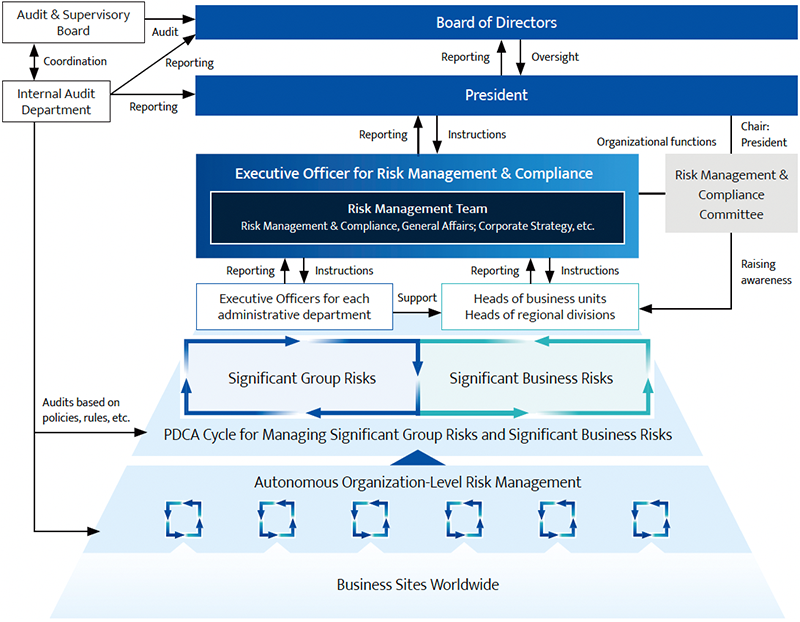
Risk management through Group-wide activities and individual business department activities
We clearly designate the risk response leader in the administrative departments and business departments, establish autonomous risk management by each organization as a foundation, and then implement risk management with regular inclusion of a Group-wide perspective.
Significant Group Risks are risks that may severely impact management across the entire Group. These risks are established by a resolution by the Board of Directors, and the administrative department takes the lead in managing these risks in an interorganizational manner. Significant Business Risks are risks that may severely impact a business or may hinder the achievement of annual management plans based on the business’s unique characteristics. Each business department selects these risks, implements countermeasures, and reports all response conditions to the Board of Directors. The Asahi Kasei Group engages in risk management as a combination of these two activities.
Furthermore, starting in fiscal 2024, we will reinforce organizational risk management activities that are closer to the workplace, as we engage in initiatives to strengthen workplace-focused awareness.
Risk management PDCA cycle (Significant Group Risks and Significant Business Risks)
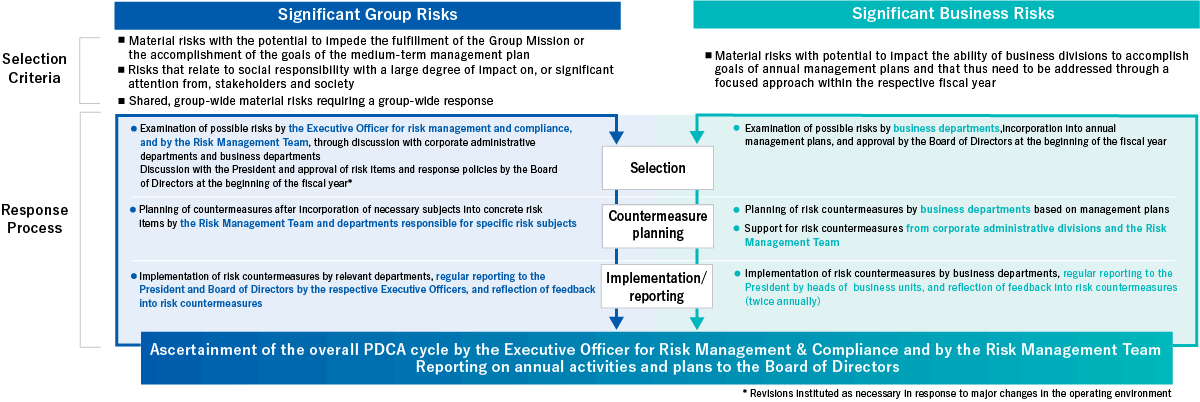
Significant Group Risks and course of action regarding the principal initiatives in fiscal 2025
| Significant Group Risks | Course of action regarding the principal initiatives | |
|---|---|---|
| Risks of accidents at Japanese and overseas production sites, and risks involving laws and regulations on the environment, safety and health |
|
|
| Quality fraud risk in Japan and overseas (including risks related to laws, regulations, and certifications, etc.) |
|
|
| Risks related to economic security and global supply chains | Risks related to US tariff policy |
|
| Risks related to tighter economic sanctions and export control regulations (both upstream and downstream) |
|
|
| Risks related to corporate activities due to geopolitical issues |
|
|
| Risks related to human rights (both upstream and downstream) |
|
|
| Risks related to procurement of raw materials and other materials |
|
|
| Risks related to cybersecurity and the management of technical information | Risks related to cybersecurity and communications infrastructure |
|
| Risks of technical information leakage |
|
|
| Risks related to natural disasters, pandemics, terrorism and conflicts | Head office and office districts (Japan and overseas) |
|
| Manufacturing sites (Japan and overseas) | ||
The following other risks are monitored by the Board of Directors as risks that may have a significant impact on the Group's management.
| Other significant risks | Course of action regarding the principal initiatives |
|---|---|
| Risks related to M&A |
|
| Risks related to climate change |
|
Risk management system based on external standards
To ensure transparency in its risk management system and reporting, the Group references external standards that include frameworks and standards such as the GRI, the Ministry of the Environment “Environmental Reporting Guidelines (2018),” SASB Standards, ISO 26000, and others.
Handling ESG risks
In light of environmental issues such as climate change as well as changes in industrial structure, decreases in the working population, and so on, it is possible that new ESG-related risks will become apparent from social changes related to sustainability. We address these ESG risks as a vital management issue. In particular, given that our businesses rely heavily on energy, addressing climate change is essential, and we consider it to present both risks and opportunities in terms of management.
Based on this mindset, we conducted an analysis of the risks and opportunities present in the various scenarios that could result from climate change based on their level of severity in keeping with the recommendations of the TCFD (Task Force on Climate-related Financial Disclosures) and devised countermeasures. We are working to make responsible parties in Corporate Strategy and each business sector aware of these results and take appropriate action.
Information Security
Recognizing the importance of countermeasures to protect against information security risks, we established the Asahi Kasei Group Information Security Policy and aim to ensure and further improve information security. In particular, due to the sharp rise and growing sophistication of cyber-attacks, we are strengthening detection and response tools, building any timely escalation and response systems in the case of an incident, and implementing security awareness-raising policies for employees globally through e-learning and email training.
Asahi Kasei Group Information Security Policy
For the protection of information assets, including customer information, and for the safe and sustainable provision of products and services, the Asahi Kasei Group recognizes that ensuring information security is an important management responsibility. To fulfill this responsibility, the Asahi Kasei Group declares that it faithfully applies its established information security policy under the leadership of management.
- 1.Legal Compliance
We comply with laws and internal regulations concerning information security. - 2.System Establishment
We have an established system to safeguard information security throughout the organization. - 3.Implementation of Countermeasures
We address the requirements of relevant stakeholders, including the government and relevant ministries and agencies, and implement appropriate information security countermeasures corresponding to our information assets, in order to prevent information security incidents. In the event that an incident occurs, we respond swiftly and appropriately, strive to minimize any damage, and endeavor to prevent any recurrence. - 4.Education of Employees
We provide information security training to all employees to ensure full awareness of the importance of information security and the proper use of information assets. - 5.Continuous Improvement
We continuously assess our efforts for information security, and apply improvements as necessary.
Revised March 24, 2026
Protection of Personal Information
The Asahi Kasei Group is committed to the proper handling of personal information as we are aware of the serious responsibility to properly manage personal information we obtain and use, and we have formulated regulations for handling personal information at each company in accordance with the Asahi Kasei Group Principles for Personal Information Management. An information security handbook which describes our rules for handling information is distributed to all employees, and education is performed via e-learning.
Protection of intellectual property
In order to prevent the unintentional leakage of important technical information to outside the Asahi Kasei Group, we have enacted management regulations and issued “Guidelines for the Prevention of Technology Leakage from Technology Sites” and “Guidelines for the Prevention of Technology Leakage through Licensing.” We are also committed to centralizing management of important technical information at each business unit, reporting to Management Council, expanding improvement activities, and implementing educational and awareness-raising activities for employees such as e-learning, etc.
For more information about our intellectual property, please refer to the Asahi Kasei Group Intellectual Property Report.
Crisis response system
Due to accidents, incidents, or problems, if Asahi Kasei Group operations are significantly damaged or the business activities of our Group would cause serious adverse effects on the general public, we have a system to establish a group emergency response headquarters which works with the relevant departments to ensure that the proper response is taken.
In fiscal 2017, we established the Asahi Kasei Group Emergency Response Regulation which stipulates basic policy when an emergency occurs, standards to institute an Emergency Response Headquarters, and the functions thereof.
Regarding response to natural disasters, we have formulated risk assessments, a damage mitigation plan, and an emergency response plan for each production site, as we pursue countermeasures that include continual training. In addition, at the head office location in fiscal 2024, we compiled an Asahi Kasei Group Safety Measures Headquarters Manual as preparation for a large-scale earthquake, and confirmed our first-response readiness at the safety measures headquarters with training and implementation of a hypothetical large-scale disaster. Moving forward, we will implement natural disaster training using different hypothetical conditions, prepare BCPs, and ensure that our countermeasures are even more thorough.